Buying Land in Paulding County GA: Zoning, Setbacks, Animals & Building Rules
You Own the Property… But What Can You Actually Do With It?
What Paulding County Homeowners & Land Buyers Need to Know Before Buying, Building, Adding Animals or Planning a Homestead
One of the biggest misconceptions we hear in real estate is:
“It’s my property. I own it, so I should be able to do what I want with it.”
You absolutely own your property, but ownership does not eliminate zoning, building codes, setbacks, easements, septic requirements, floodplain rules, animal regulations, recorded subdivision restrictions, or municipal ordinances.
And in Paulding County, knowing which government actually has jurisdiction over the property is the first step.
Paulding County is NOT the same thing as the City of Dallas or Hiram
There are three incorporated municipalities within Paulding County: Dallas, Hiram, and Braswell. Properties inside those city limits can be governed by municipal zoning and development ordinances that differ from those applicable in unincorporated Paulding County.
That means having a Dallas, GA mailing address does not mean you should automatically assume Paulding County zoning rules apply. In fact, the City of Dallas specifically instructs permit applicants to confirm that the property is within Dallas city limits before submitting a permit application and recommends checking the tax district to determine jurisdiction.
Dallas also has its own current Unified Development Code, zoning map, and Community Development Department. Hiram likewise maintains its own Unified Development Code.
This article focuses primarily on unincorporated Paulding County. We are going to separately break down Dallas, Hiram, and Braswell in future articles because those city boundaries matter.
Your Zoning Classification Matters More Than Your Acreage
Buying five acres does not automatically mean you bought a “farm.”
Buying two acres does not automatically mean you can have goats.
And buying an empty lot does not automatically mean you can put whatever size home you want on it.
Paulding County's Planning & Zoning Division administers the County's zoning ordinance and specifically provides zoning verification and zoning-compliance information to property owners, Realtors, builders, and developers. The County also maintains an online zoning map.
Here are some of the major residential/agricultural zoning standards currently found in the County UDO:
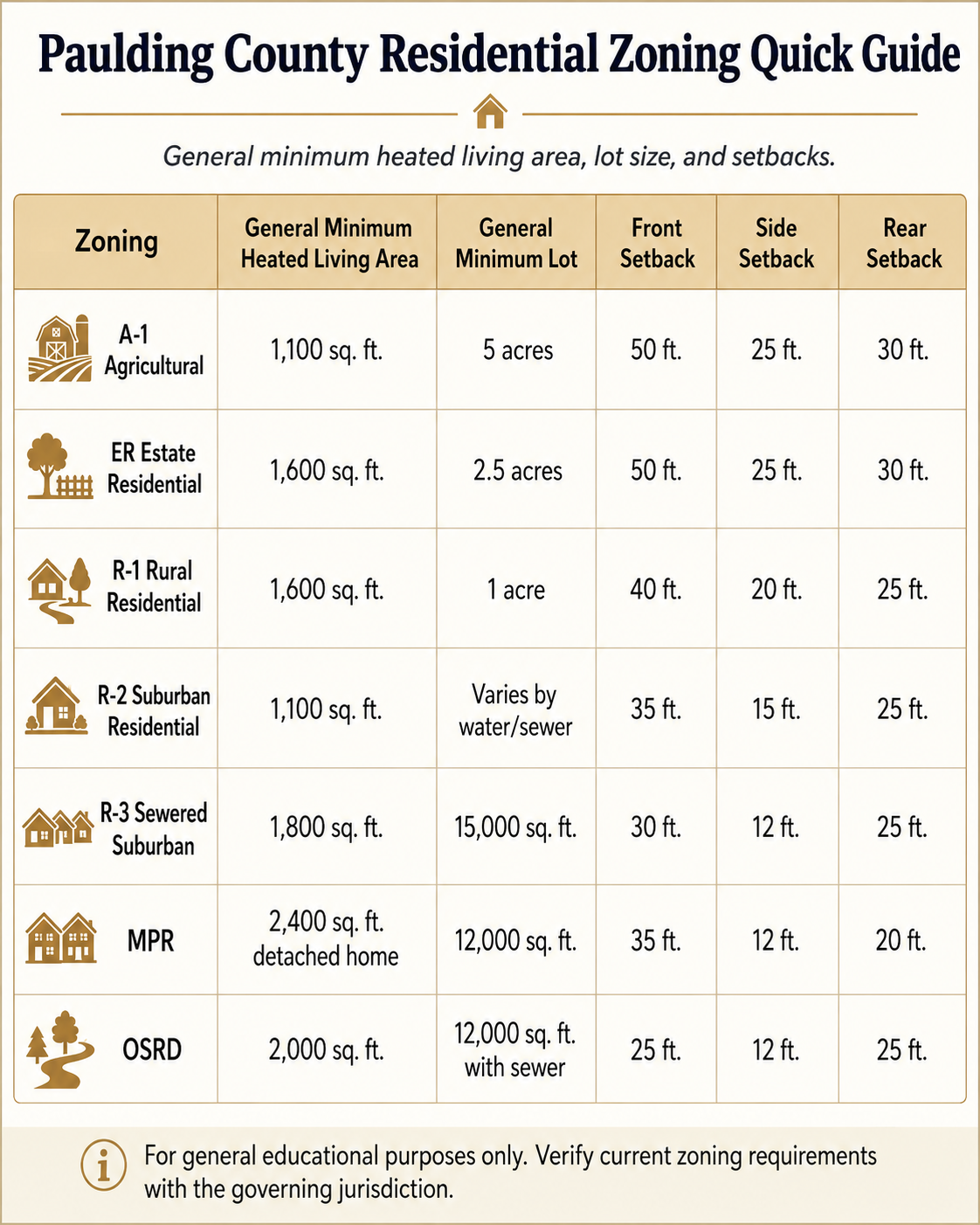
These are general district standards, not a guarantee for an individual parcel. Recorded zoning stipulations, overlays, subdivision plats, buffers, easements, and other site-specific conditions can change what can actually be built.
This is exactly why someone buying land for a small cottage, tiny home, barndominium, or custom home should investigate before closing. For example, simply buying a large tract does not automatically permit a 700-square-foot principal residence.
Setbacks Can Completely Change a “Perfect” Building Lot
A five-acre property sounds enormous until you start subtracting: road right-of-way, front setback, side setbacks, rear setback, septic field and replacement area, streams and buffers, easements, floodplain, steep terrain, driveway placement, wells and utility corridors.
Suddenly, the actual buildable envelope can be dramatically smaller than the acreage listed.
Paulding County requires a current survey for private-dwelling approvals outside a platted subdivision, including street right-of-way and easement information. The private dwelling approval process also runs through Community Development, Environmental Health, the Tax Assessor, transportation, and water/sewer before the building permit is issued.
So when someone says:
“There are five acres. We can just put the house over there.”
Maybe.
But we need to verify it.
Owning Acreage Does NOT Automatically Mean You Can Have Whatever Animals You Want
This one surprises people.
Paulding County distinguishes between ordinary household pets, backyard chickens, animal production, kennels, breeding operations, hog/pig farming, and other animal-related uses.
In A-1 and AB districts, animal-production areas generally must be at least 100 feet from the front property line and 50 feet from the side and rear property lines.
In ER, R-1 and R-2, qualifying animal-production uses have dramatically larger standards: generally 300 feet from the front and 200 feet from the side and rear property lines. Animals other than ordinary household pets must also be kept within a structure, pen, or corral rather than roaming freely.
Depending upon the zoning and specific animal use, a Special Exception or Special Use Permit may be required.
So acreage alone isn't the question.
The question is:
What is the property zoned, what animals do you intend to keep, where will they be housed, and can the parcel physically satisfy the required setbacks?
That difference can make or break a homestead plan.
Even Chickens Have Rules 🐓
Yes.. even backyard chickens.
For qualifying properties in unincorporated Paulding County, the County's rules generally provide for a maximum of five backyard chickens. The coop may not exceed 200 square feet, must be fully enclosed, must be in the rear yard, and generally needs to be:
100 feet from the front/right-of-way, 45 feet from the side and rear property lines, and at least 45 feet from the owner's residence.
The chickens cannot free-range or roam at large under these backyard-chicken provisions, and the County prohibits using backyard chickens for slaughter or breeding purposes.
Roosters have significantly greater location requirements; the County's chicken guidance indicates the shelter must be 300 feet from the front and 200 feet from the side and rear property lines.
Again, what sounds like plenty of land may not work once you actually draw those circles around the property.
What About a Second House for Mom, Dad, or the Kids?
This is another area where buyers should never assume.
Paulding County's private dwelling guidance generally contemplates one dwelling per parcel, but its zoning ordinance provides a specific Special Exception path for qualifying guest houses in A-1, ER, R-1, and R-2.
Under those standards, a guest house generally requires at least two total acres, must contain at least 800 heated square feet, must have sewer or an approved septic system, and may be occupied by a bona fide non-paying guest or relative. It cannot simply be turned into a rental, nor can it be sold separately from the principal home.
So if your plan is:
“We'll build our house and put another little house out back for Mom.” That is something we should investigate before you buy the land, not after.
Manufactured, Modular, and Mobile Homes Are NOT All Treated the Same
This is another huge one.
Paulding County distinguishes among singlewide manufactured homes, doublewide/larger manufactured homes, and modular homes.
The County states that singlewides are limited to manufactured-home parks. Doublewides generally cannot be placed within platted subdivisions, although qualifying R-2 and A-1 properties may allow them under applicable requirements. Modular homes may be permitted within subdivisions when they comply with the subdivision's applicable minimum-size requirements.
So when someone buys land because a listing says:
“Perfect for your manufactured home!”
Our next question should be:
“According to whom?”
We need to verify that before closing.
Barns, Shops, Detached Garages, and Storage Buildings Have Rules Too
Accessory structures are another area where people assume acreage equals freedom.
Under the County's supplemental standards, non-agricultural accessory buildings and structures generally must be set back at least 10 feet from the side and rear property lines unless a larger setback or buffer applies. They generally cannot project into the required front-yard setback and cannot be used for human occupancy.
Paulding County also has permitting applications specifically for barns, garages, additions, remodeling, storage buildings, and certain fences.
So that future:
40×60 shop, detached garage, barn, she-shed, pool house, or equipment building needs to be part of the property evaluation too.
Pools, Decks, Basements, and Retaining Walls Can Require Permits
Buying an existing home doesn't eliminate these issues.
Paulding County states that permits are required for deck construction/replacement and basement finishing. Retaining walls over four feet require engineering and permitting, and above-ground pools also require permits. The County says residential pools generally need at least a 10-foot offset from side and rear property lines behind the home and cannot interfere with the septic system or field lines.
This is why buyers should also pay attention to whether major improvements on an existing property were properly permitted.
Septic Can Decide Where or Whether You Build
A pretty piece of land isn't enough. For property requiring a septic system, Environmental Health approval becomes part of the equation. Paulding County's private-dwelling process specifically requires a septic permit, where applicable, before construction proceeds.
R-2 is a great example of why utilities matter. Its minimum lot size changes depending upon the water and sewage arrangement:
20,000 sq. ft. with public sewage and public water,
21,780 sq. ft. with on-site sewage and public water, or
43,560 sq. ft. with on-site sewage and a non-public/individual water supply.
Your septic location can also affect where the house, driveway, pool, barn, and future additions can go.
Creeks, Floodplains, and Beautiful Woods Can Come With Restrictions
That creek running across the back of a property may be gorgeous.
It may also affect development.
Paulding County's Development Division administers floodplain management, stream-buffer protection, stormwater requirements, erosion control and land-disturbance permitting.
Properties within special flood-hazard areas can require elevation certificates during construction, and County floodplain regulations restrict development within certain stream areas.
So water features, wetlands, drainage easements, and flood zones need to be reviewed before someone designs the house around an assumed building site.
Want to Run a Business From Home?
Zoning matters there too.
Paulding County provides for home occupations in multiple residential districts, but its rules restrict the scale and appearance of those businesses. Among other things, generally no more than one room and no more than 25% of the dwelling's gross floor area may be devoted to the home office, and the business cannot visibly alter the residential character or create nuisances.
Larger residential or rural businesses may require a Land Use Permit.
So if your dream property needs to support your landscaping company, mechanic shop, salon, plant nursery, farm sales, or another business, tell your Realtor that before you purchase.
Don't Forget the HOA, Plat, and Recorded Restrictions
Government approval is only one layer.
A subdivision may also have recorded covenants, architectural standards, HOA rules, and plat restrictions.
In fact, several Paulding County residential zoning districts expressly require mandatory homeowners associations for newly developed subdivisions, with rules concerning items such as fences, landscaping, buffers, private streets, stormwater facilities, and common areas.
A use allowed by the County does not necessarily mean a private subdivision's recorded restrictions allow it.
You need to look at both.
Before You Buy Land or a Home in Paulding County, Ask These Questions
- Is the property actually in unincorporated Paulding County or inside Dallas, Hiram, or Braswell city limits?
- What is the current zoning classification, not just what the listing says?
- Are there zoning stipulations, overlays, or previous rezoning conditions attached to the parcel?
- What are the minimum house size, lot size, frontage, and required setbacks?
- Where are the recorded easements and rights-of-way?
- Is public sewer available, or will Environmental Health need to approve a septic system?
- Is any portion in a floodplain, wetlands, or a stream-buffer area?
- Can the driveway location actually be approved by County DOT or GDOT?
- Are the animals you want permitted, and can their shelters meet the setbacks?
- Can you legally build the barn, shop, guest house, pool, or second structure you envision?
- Are manufactured or modular homes permitted?
- Are there HOA covenants, deed restrictions, or recorded plat requirements that are stricter than County rules?
- If you intend to operate a business, farm stand, nursery, or other income-producing activity, is that use permitted?
- For an existing property, were additions, finished basements, decks, pools, and other major improvements properly permitted?
That research should happen before your due-diligence period disappears, and preferably before you ever write the offer.
This Is Where the Right Real Estate Representation Matters
At Buy Georgia Realty, our job isn't simply to open a door and show you a pretty house or piece of land.
If you're purchasing property to build, homestead, keep animals, add a workshop, create multigenerational living, run a business, grow food,, or simply have more freedom, those goals matter when selecting the property.
A five-acre property that doesn't accommodate the life you want to live may be a worse purchase than a two-acre property that does.
We help our buyers identify the questions to ask, research the property and its jurisdiction, review available zoning and property information, and connect the dots before you commit your money to a property that may not fit your plans.
🏡 Thinking about buying a home, acreage, or land in Paulding County?

Don't just buy the property. Make sure you're buying the ability to live the life you're planning for.
This article is for general educational purposes. Zoning ordinances, municipal codes, and development standards can change, and individual parcels may be subject to zoning stipulations, overlays, recorded plats, easements, covenants, and other restrictions. Always verify current requirements with the governing jurisdiction and appropriate professionals before purchasing, designing, or beginning construction.
Categories
- All Blogs (121)
- Advocate (9)
- Appraisals (4)
- Avoiding Probate (1)
- Brokerage (13)
- Building (2)
- Buying (58)
- Career (1)
- Closing Insurance (1)
- Commercial (2)
- Commission (2)
- Compensation (1)
- Cortney Michelle (1)
- Decor (1)
- Divorce (2)
- Divorce Decree (1)
- Due Diligence (2)
- DYI (1)
- Embracing the Downsizing Journey (5)
- Enhancing Appeal through Upgrades and Staging (2)
- Equity (2)
- Estate Planning (2)
- Exploring Retirement Living Options (1)
- FHA (3)
- Financing & Mortgage Tips (3)
- First Time Buying (16)
- Friendship (3)
- Georgia Real Estate (33)
- Georgia, USA (38)
- Growing (3)
- Hidden Protection (9)
- Highlighting Unique Features (2)
- HOA (4)
- Holiday Events (3)
- Home Inspection (7)
- Home Maintenance (5)
- Homebuyer Education (5)
- Homeowner Protection (17)
- Homeownership (43)
- Insurance (3)
- Janae Garrett (1)
- Land Trust (1)
- Lease Negotiation (2)
- Lender's Title Insurance (1)
- Lending (10)
- Licensed and Insured (1)
- Market (19)
- Marriage (1)
- Melissa St. Germain (1)
- Mortgage (5)
- Moving (11)
- NAR Settlement (2)
- New Home Journey (14)
- Owner's Title Insurance (1)
- Packing (2)
- Paulding, GA (1)
- Professional Advice (20)
- Property Damage (1)
- Property Taxes (4)
- Quitclaim Deed (1)
- Real Estate (55)
- Real Estate Closing Attorney (5)
- Relocation (15)
- Renee Sneed (1)
- Research and Review (5)
- Retirement Living (3)
- Sales and Acquisitions (4)
- Selling (29)
- Senior Home Solutions (4)
- Senior Housing (3)
- Seniors (4)
- Smart Pricing and Incentives (1)
- Summer (3)
- Title Search (2)
- Transfer Ownership Rights (1)
- VA Home Buying (4)
- VA Loans (1)
- Zoning (2)
Recent Posts





GET MORE INFORMATION