Agricultural Preferential Assessment vs. CUVA in Georgia: What Property Owners Need to Know Before Buying, Selling, or Changing the Land

Georgia offers several property tax programs intended to help preserve agricultural land, timberland, and other qualifying property. Two of the programs most commonly confused are Preferential Agricultural Assessment and Conservation Use Valuation (CUVA).
Although both programs can provide significant property tax savings, they are not the same. They value property differently, have different qualification requirements, and carry different penalties if a property owner breaks the covenant before it expires.
For buyers and sellers of Georgia land, understanding that distinction is important. A property may appear to have unusually low property taxes because it is enrolled in one of these programs, but those tax savings may also come with a long term commitment that can affect a future sale, transfer, subdivision, or change in use.
Agricultural Property Does Not Automatically Mean CUVA
The word “agricultural” can mean several different things when discussing Georgia real estate. A property may have agricultural zoning, be actively used for farming, receive a Preferential Agricultural Assessment, or be enrolled in CUVA.
Those are separate issues.
Agricultural zoning primarily concerns how a local government allows property to be used. Preferential Agricultural Assessment and CUVA relate to how qualifying property is valued for property tax purposes.
This is why simply seeing “agricultural” on a listing, tax record, or zoning map does not confirm that a property is enrolled in CUVA.
Before purchasing or selling acreage, the property's actual tax status should be verified with the county Board of Tax Assessors.
What Is Preferential Agricultural Assessment?
Georgia’s Preferential Agricultural Assessment is designed for qualifying property being used for bona fide agricultural purposes.
Under Georgia’s normal property tax system, real property is generally assessed at 40 percent of fair market value. Qualifying property receiving the agricultural preferential assessment is instead assessed at 30 percent of fair market value.
The program can apply to qualifying agricultural activities such as farming, livestock production, horticulture, forestry, poultry operations, beekeeping, and other bona fide agricultural uses.
To receive the preferential assessment, the owner generally enters into a ten year covenant agreeing that the property will remain devoted to qualifying agricultural purposes.
The most important characteristics of the program include:
- Qualifying agricultural use is required.
- The covenant generally lasts ten years.
- The land is assessed at 30 percent of fair market value rather than the normal 40 percent assessment.
- A residence located on the property does not receive the same preferential agricultural treatment.
- Breaking the covenant early may result in a financial penalty.
This program can provide meaningful savings while still tying the taxable value to the property’s fair market value.
What Is CUVA?
CUVA stands for Conservation Use Valuation Assessment. It also generally involves a ten year covenant, but the way the property is valued is substantially different.
Rather than valuing qualifying land primarily by its fair market value, CUVA values the property based on its current qualifying use.
That difference can be significant in areas where land values have increased because of residential or commercial development.
For example, agricultural acreage near a rapidly growing Georgia community may have a high market value because a builder or developer would be willing to purchase it. If the property qualifies for CUVA, its taxable value may instead be based upon its agricultural, timber, or conservation use.
That can create substantial property tax savings.
CUVA may apply to qualifying uses, including farming, timber production, livestock, and other bona fide conservation uses permitted under Georgia law.
Some of the key characteristics include:
- The covenant generally lasts ten years.
- Property is valued based on its qualifying current use rather than its full market potential.
- Significant tax savings may be available, particularly in areas where land values are increasing quickly.
- The property must continue to meet the qualifying use requirements.
- Early breach of the covenant can result in a substantial penalty.
Because the savings under CUVA can be greater, the financial consequences of breaking the covenant can also be greater.
The Difference in Property Valuation
The easiest way to understand the two programs is to look at how the taxable value is determined.
Under normal Georgia property taxation, real property is generally assessed at 40 percent of fair market value.
Under Preferential Agricultural Assessment, qualifying agricultural property is generally assessed at 30 percent of fair market value.
CUVA works differently because qualifying land is valued based upon its current use value, rather than simply reducing the assessment percentage applied to fair market value.
That difference becomes especially important when the market value of land has increased dramatically while the property continues to be used for agriculture or timber.
A property owner may therefore receive a much larger tax benefit through CUVA than through the agricultural preferential program, depending upon the property.
Both Programs Come With a Long Term Commitment
One of the most important things for a Georgia landowner to understand is that these programs are not simply annual tax discounts.
They involve a covenant.
When a property owner enrolls qualifying property, the owner is generally making a ten year commitment regarding how the property will be used.
That commitment should be considered carefully if there is any possibility that the property may be:
- Sold for development.
- Divided into multiple parcels.
- Transferred to family members.
- Converted to commercial use.
- Removed from agricultural or timber production.
- Used for a purpose that may no longer qualify under the program.
Plans can change considerably over ten years, which is why understanding the covenant before enrolling property is so important.
Penalties for Breaking a Preferential Agricultural Covenant
The penalty structure for Preferential Agricultural Assessment differs from that of CUVA.
When a preferential agricultural covenant is breached, Georgia law generally bases the penalty on the amount of tax savings received during the year of the breach. That amount is multiplied according to how far the property owner is into the ten year covenant.
The multiplier decreases as the covenant gets older:
- Years 1 and 2 generally use a multiplier of 5.
- Years 3 and 4 generally use a multiplier of 4.
- Years 5 and 6 generally use a multiplier of 3.
- Years 7 through 10 generally use a multiplier of 2.
For example, if the preferential assessment saved a property owner $4,000 in taxes during the year of the breach, and the breach occurred in the second year of the covenant, the basic penalty could be approximately $20,000, before considering any applicable interest or other charges.
If that same breach occurred much later in the covenant, the multiplier would be lower.
CUVA Penalties Can Be Much Larger
CUVA uses a different penalty calculation.
When a CUVA covenant is improperly breached, the standard penalty is generally based upon twice the total property tax savings received during the covenant period up to the time of the breach.
That means the penalty can accumulate over several years.
For example, if a property owner saved approximately $4,000 per year for six years through CUVA, the cumulative savings would be approximately $24,000. A penalty calculated at twice those savings could reach approximately $48,000.
This is one of the most important differences between CUVA and the agricultural preferential program.
A property owner should never assume that leaving CUVA simply means repaying one year of tax savings. Depending on how long the property has been enrolled and the amount of savings received, the penalty can become substantial.
Selling CUVA Property Does Not Always Break the Covenant
The sale of a property does not automatically mean the CUVA covenant has been breached.
Georgia law allows certain transfers in which a qualifying new owner may continue the existing covenant. The details, however, matter, and the new owner may need to meet specific requirements.
This is especially important in a real estate transaction because a buyer may be purchasing property subject to an existing covenant that continues after closing.
Before purchasing property subject to CUVA or another agricultural covenant, buyers should understand:
- Which covenant currently applies to the property.
- When the covenant began.
- When it expires.
- Whether the entire parcel is included.
- Whether the buyer’s intended use will continue to qualify.
- Whether the covenant will transfer with the property.
- Whether any proposed division or change in use could create a breach.
These questions should be addressed before closing whenever possible.
Family Transfers Can Have Special Rules
Georgia law also recognizes that agricultural and family land sometimes needs to be transferred to relatives.
Under certain circumstances, portions of covenant property may be transferred to qualifying family members without causing the entire covenant to be breached. Some provisions allow transfers of up to five acres when statutory requirements are satisfied.
This can be particularly important when a parent or other family member wants to provide acreage for a relative to build a residence.
However, family transfer provisions have specific requirements involving the relationship between the parties, use of the land, construction, occupancy, and other factors.
A deed should not be recorded based solely on the assumption that a family transfer automatically qualifies.
The county Board of Tax Assessors should be contacted before the property is divided or transferred so that the owner understands exactly what will be required.
Small Properties May Still Qualify
Another misconception is that CUVA is available only to large farms.
Georgia does not generally require a massive tract of land simply because the owner is seeking conservation use valuation. However, smaller parcels may receive additional scrutiny.
Properties containing fewer than ten acres may require additional documentation demonstrating that the land is actually being used for a bona fide qualifying purpose.
Simply owning acreage or maintaining a garden does not automatically make a property eligible.
Qualification is based upon the actual use of the property and the requirements established under Georgia law.
Buyers Should Pay Attention to Unusually Low Property Taxes
A low property tax bill can be attractive when looking at acreage, but buyers should understand why the taxes are low.
If the tax savings result from CUVA or another agricultural covenant, the buyer may be purchasing more than just land. They may also be assuming responsibilities associated with that covenant.
Before making an offer on agricultural or conservation property, the tax records should be reviewed carefully.
The buyer’s intended use matters as well. Someone purchasing land to continue farming may be in a very different position from someone intending to immediately subdivide or develop the property.
Sellers Should Understand the Covenant Before Listing
Landowners preparing to sell property should determine whether any agricultural or conservation covenant affects the property before placing it on the market.
The covenant may affect how the property is marketed, which buyers are appropriate, how the transaction is structured, and the seller’s actual proceeds.
This becomes especially important when property is being marketed for development.
A seller may receive an attractive offer from a developer but later discover that changing the property's use would trigger a substantial CUVA penalty. That amount can materially affect the seller’s net proceeds.
Understanding the covenant before negotiating the sale allows the owner to make a much more informed decision.
Agricultural Zoning and CUVA Are Separate Issues
Agricultural zoning does not automatically provide CUVA tax treatment, and CUVA does not automatically determine what activities local zoning regulations permit.
A buyer purchasing rural property should investigate both.
The tax assessor can provide information regarding CUVA and property tax treatment, while the county or city planning and zoning department can provide information regarding permitted land uses.
Someone planning livestock, additional homes, farming operations, commercial agricultural activity, short term rentals, event venues, or other uses should verify those issues independently.
Before Changing the Property, Verify the Covenant
CUVA and Georgia’s Preferential Agricultural Assessment can provide significant benefits to property owners who intend to keep land in agricultural, timber, or conservation use.
Problems often arise when owners do not realize how a future sale, division, transfer, or change in use may affect the covenant.
Before making a significant change to property enrolled in one of these programs, it is wise to verify the specific parcel with the county Board of Tax Assessors.
For more complicated situations, particularly those involving substantial acreage, development, family transfers, or potentially large penalties, consulting a Georgia real estate or tax attorney before recording documents can provide additional protection.
Understanding the covenant before making the change is considerably easier than correcting an unexpected tax problem afterward.
Quick Comparison
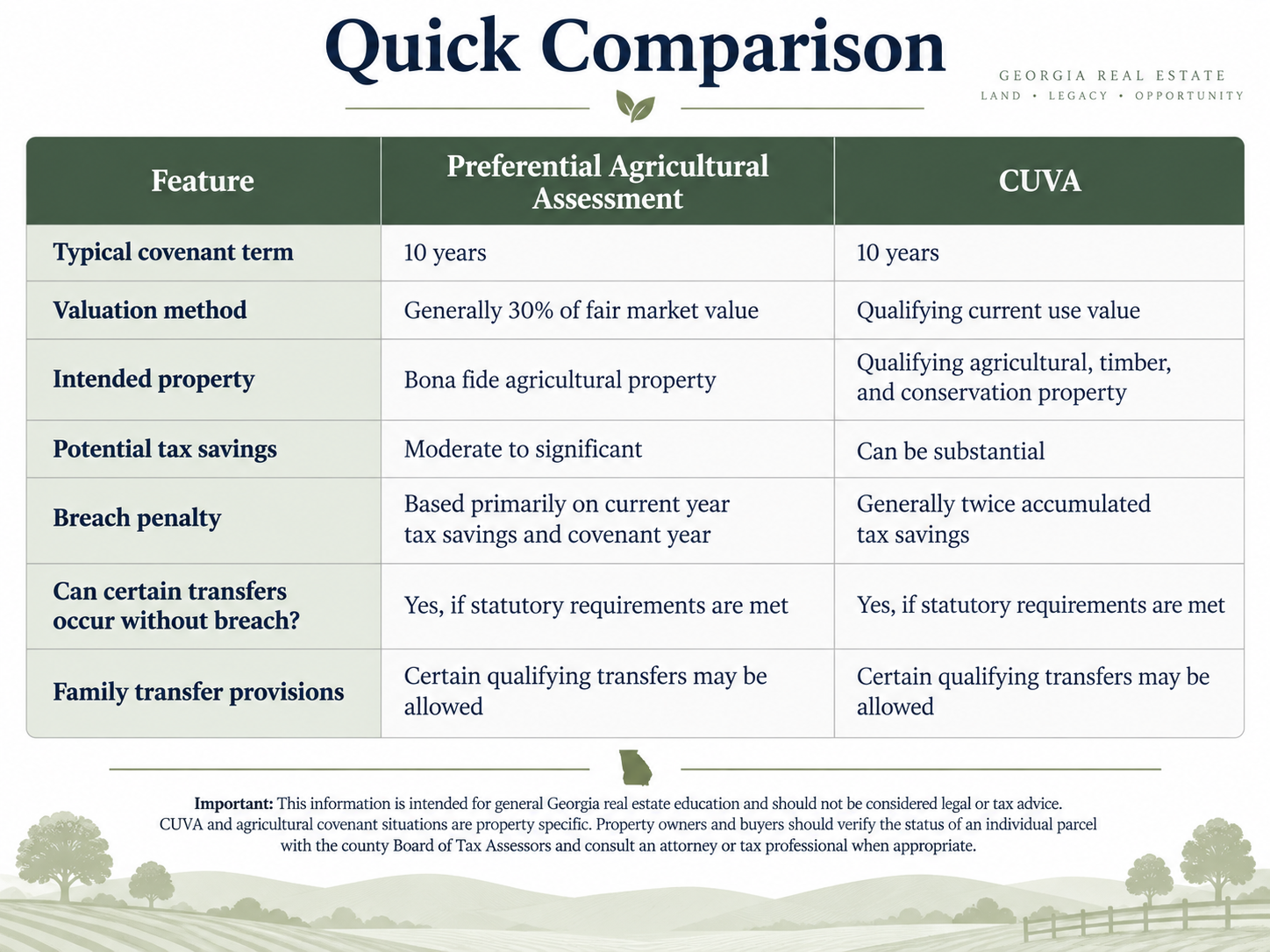
Important: This information is intended for general Georgia real estate education and should not be considered legal or tax advice. CUVA and agricultural covenant situations are property specific. Property owners and buyers should verify the status of an individual parcel with the county Board of Tax Assessors and consult an attorney or tax professional when appropriate.

Frequently Asked Questions About CUVA and Agricultural Assessment in Georgia
Is agricultural property automatically enrolled in CUVA?
No. Agricultural zoning, agricultural use, Preferential Agricultural Assessment, and CUVA are separate matters. The property’s actual tax status should be verified with the county Board of Tax Assessors.
How long is a Georgia CUVA covenant?
CUVA generally requires a ten year covenant during which the property must continue to meet the qualifying use requirements.
What happens if a CUVA covenant is broken early?
A breach can result in a substantial tax penalty. The standard CUVA penalty is generally based on twice the accumulated property tax savings received during the covenant period, although exceptions may apply depending on the circumstances.
Can CUVA property be sold without a penalty?
Sometimes. Certain qualifying transfers may allow the covenant to continue rather than being breached. The specific transfer and intended use should be reviewed with the county before closing.
Can part of CUVA property be transferred to a family member?
Georgia law provides certain family transfer provisions that may allow qualifying acreage to be transferred without breaching the entire covenant when statutory requirements are satisfied.
Categories
- All Blogs (121)
- Advocate (9)
- Appraisals (4)
- Avoiding Probate (1)
- Brokerage (13)
- Building (2)
- Buying (58)
- Career (1)
- Closing Insurance (1)
- Commercial (2)
- Commission (2)
- Compensation (1)
- Cortney Michelle (1)
- Decor (1)
- Divorce (2)
- Divorce Decree (1)
- Due Diligence (2)
- DYI (1)
- Embracing the Downsizing Journey (5)
- Enhancing Appeal through Upgrades and Staging (2)
- Equity (2)
- Estate Planning (2)
- Exploring Retirement Living Options (1)
- FHA (3)
- Financing & Mortgage Tips (3)
- First Time Buying (16)
- Friendship (3)
- Georgia Real Estate (33)
- Georgia, USA (38)
- Growing (3)
- Hidden Protection (9)
- Highlighting Unique Features (2)
- HOA (4)
- Holiday Events (3)
- Home Inspection (7)
- Home Maintenance (5)
- Homebuyer Education (5)
- Homeowner Protection (17)
- Homeownership (43)
- Insurance (3)
- Janae Garrett (1)
- Land Trust (1)
- Lease Negotiation (2)
- Lender's Title Insurance (1)
- Lending (10)
- Licensed and Insured (1)
- Market (19)
- Marriage (1)
- Melissa St. Germain (1)
- Mortgage (5)
- Moving (11)
- NAR Settlement (2)
- New Home Journey (14)
- Owner's Title Insurance (1)
- Packing (2)
- Paulding, GA (1)
- Professional Advice (20)
- Property Damage (1)
- Property Taxes (4)
- Quitclaim Deed (1)
- Real Estate (55)
- Real Estate Closing Attorney (5)
- Relocation (15)
- Renee Sneed (1)
- Research and Review (5)
- Retirement Living (3)
- Sales and Acquisitions (4)
- Selling (29)
- Senior Home Solutions (4)
- Senior Housing (3)
- Seniors (4)
- Smart Pricing and Incentives (1)
- Summer (3)
- Title Search (2)
- Transfer Ownership Rights (1)
- VA Home Buying (4)
- VA Loans (1)
- Zoning (2)
Recent Posts









GET MORE INFORMATION